PPC vs. SEO: How to Balance Short-Term Paid Acquisition with Long-Term Organic Growth
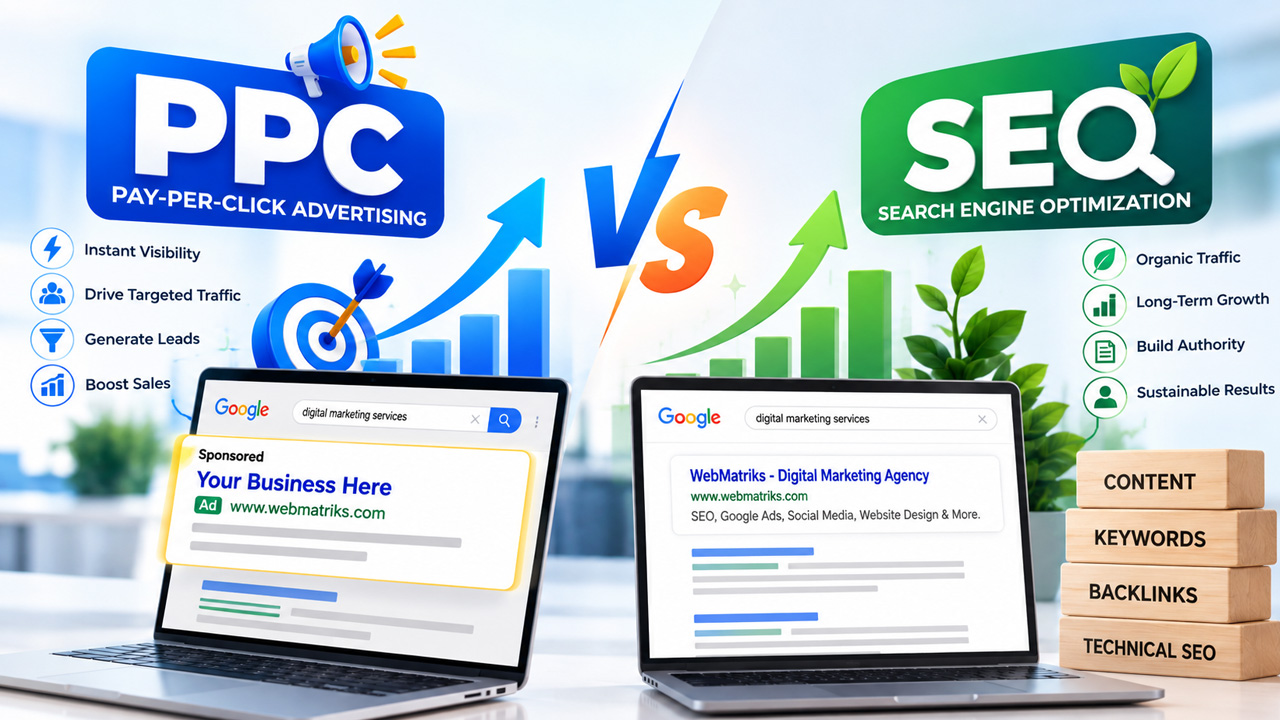
Pay-Per-Click advertising (PPC) and Search Engine Optimization (SEO) are two channels of digital marketing that can be used to drive traffic to a website and achieve marketing goals. PPC is a marketing channel that allows marketers to quickly tap into a customer base. This marketing strategy is focused on achieving and improving visibility of a web page in the organic listings of a search engine.
Marketing Budget Strategy
Given the nature of the two marketing channels, a successful marketing strategy should incorporate both PPC and SEO.
PPC is ideal for quickly achieving marketing goals. Given the cost involved with PPC, marketers can only realize short-term marketing goals using this strategy. The marketer can use the funds raised through the new service to finance the PPC campaign for the service.
Other benefits of using PPC include achieving marketing goals such as driving traffic to a webpage, capturing leads, and helping to achieve other marketing goals that require an immediate response such as achieving marketing goals for a promotional campaign.
Achieving PPC marketing goals helps relieve the financial constraint felt when embarking on a marketing campaign. Given the nature of PPC, marketers must be ready to continuously allocate funds to advertising to achieve marketing goals.
SEARCH ENGINE OPTIMIZATION (SEO)
Search Engine Optimization (SEO) is the process of optimizing your website to get “free” or “organic” traffic from the Search Engine Results Pages (SERPs).
Optimizing your website to improve SEO may include:
· Keyword Research
· Technical SEO
· On-page SEO
· Content Creation
· Editing and Optimizing existing content
· Link Building
· Website Architecture
· Digital PR
· User Experience
There are no costs for potential customers to click on your links through SEO, however, creating and improving content to increase your website’s visibility can be costly and time consuming.
Although the results from SEO can take a while, consistent efforts to improve your SEO can create a consistent and sustainable source of traffic to your website.
PPC vs SEO
The main difference between PPC and SEO is the process to achieve visibility.
PPC = Visibility is achieved through an ad campaign and an agreement to pay a fee each time a user clicks on the ad.
SEO = Visibility is achieved through organic results and ranking factors.
PPC can be beneficial if you want website traffic in the short term while improving your SEO can be beneficial to achieve sustainable website traffic in the long term.
In an ideal situation, a business can benefit from achieving website traffic through both SEO and PPC.
PPC and SEO Synergy
PPC and SEO can benefit each other.
A PPC campaign can provide valuable data to optimize your SEO strategy including:
· Most valuable keywords to target and use in your website content
· Most valuable and effective advertisement copy to use on your webpages
· Which user search queries lead to a conversion
· Which geographic locations lead to user conversions
· Which of your offered products and services are most in demand
SEO data provides opportunities to discover phrases and topics for paid campaigns.
This enables businesses to integrate their paid and organic search data.
Using PPC for Lead Generation and Sale
PPC works well for lead generation and sales and can be used to quickly create and test marketing campaigns.
To create a PPC campaign for lead generation, the digital marketing agency would create campaigns for:
– SEO services
– Google Ads management
– Lead generation
– Other digital marketing services
– Website design and development
PPC allows a company to quickly appear in front of users searching for their services.
However, PPC can quickly become expensive and waste a company’s marketing budget if it is not properly managed.
To help manage PPC costs, a company needs to monitor its return on ad spend (ROAS) and other costs such as customer acquisition costs (CAC) and qualified lead rates.
Using a Strong SEO Strategy for Long-Term Business Growth
Although PPC allows companies to quickly achieve first page rankings, a strong SEO strategy allows companies to create a long term first page ranking “asset” for particular keywords.
Over time, a business can use SEO to create various types of content that educate and guide potential customers.
These can include:
– Articles that compare and contrast competing services
– Articles that help users take action and contact a business
Some examples of keywords and topics for a website development company can include website costs, ecommerce website development, UX design, website redesign, and other custom website development topics.
It is anticipated that the contents in this area will improve the website’s organic search results over time.
How to Develop a Simultaneous PPC and SEO Strategy
1. Establish Different Goals and Key Performance Indicators
PPC goals may be focused on lead generation. In contrast, SEO goals may be focused on improving positioning and/ or traffic.
2. Leverage Keyword Data
Although not all targeted keywords may be reflected in search queries, commercially relevant keywords may be determined through PPC and may be targeted through SEO.
3. Leverage PPC for Landing Pages
PPC may be used to test messages and CTAs to be used on landing pages.
4. Leverage PPC Keywords for SEO Content
Keywords that are relevant and beneficial for paid content may be prioritized for organization content.
5. Evaluate Channel Performance
The focus of evaluation may be the efficiency of the effort and/or the performance of the target audience.
Although focused evaluation may be performed on the individual channels of PPC and SEO (Search Engine Optimization), the focus of the effort may be integrating the two channels to support the overall goal of the business.
PPC and SEO may be integrated to support the goals of a business to improve online presences, overall search results, and/or answer engine results.
SEO, AEO, and GEO innovations offer an opportunity to create holistic digital marketing strategies.
Rather than focusing on a single channel to bring in new customers, the objective is to invest in several, and build a suite of customer acquisition channels.
How We Can Help
Our integrated marketing solutions cover all areas of digital marketing. From SEO and PPC, to content marketing, website design, development, and AI marketing solutions, our offerings are tailored to help our clients achieve their marketing objectives.
We recognize each element of a marketing campaign is inter-related. Therefore, we take a campaign integration approach, aligning marketing activities to business goals.
Depending on your business objectives, we take a flexible approach to help you achieve your marketing goals, whether it is to maximize your marketing spend to acquire the best customers through a combination of PPC and SEO campaigns, or to build a sustainable marketing visibility funnel through a combination of SEO and other marketing campaigns.
Frequently Asked Questions
1. Is it better to use PPC or SEO for my business?
Both PPC and SEO have their own benefits and drawbacks depending on the situation. For quicker clearer results, PPC is better. Overtime, SEO will always gain your business more exposure.
2. What is the average wait time for results from a PPC campaign?
PPC can be very effective as a short-term strategy. The speed of the results depends on the market, competition, budget, offer, and other factors. The main constraint will usually be the budget.
3. Can I expect quick results from an SEO campaign?
There are many factors that affect the time it takes to get results from an SEO campaign. It can include how big your competition is, the quality of your content and your website, and how quickly your industry is changing to name a few. It is better to think of SEO as a way to gain traffic and exposure for your site over the long-term.
4. Can pay-per-click (PPC) data assist in optimizing SEO?
PPC data covers various elements that can be used to structure SEO campaigns. These include the keywords and questions users type into search engines, the kinds of ads that result in conversions, the different places that users convert, and user behavior.
5. Once a business improves its SEO and begins ranking better organically, should PPC be removed?
No, in most cases this wouldn’t be necessary. SEO and PPC function independently, and improving SEO doesn’t negate the need for PPC. PPC campaigns can be created to improve the visibility of important or newly created products, and PPC can be used to focus on specific user groups.
6. Would Webmatriks Technologies be able to create and manage PPC campaigns in addition to managing SEO campaigns?
Yes, this is definitely possible. Webmatriks Technologies has the necessary team and experience to provide management of SEO and PPC campaigns, including the management of Google and Meta advertisements. Along with management, Webmatriks Technologies can provide support with keyword research and optimization, technical and on-page changes to improve SEO and conversions, and create and manage content for user groups (AEO and GEO) based on your business requirements.
Stay informed, Stay ahead and Stay inspired with WebMatriks, A leading Digital Marketing Company in Faridabad