What is Organic Traffic & How To Drive It To Your Website
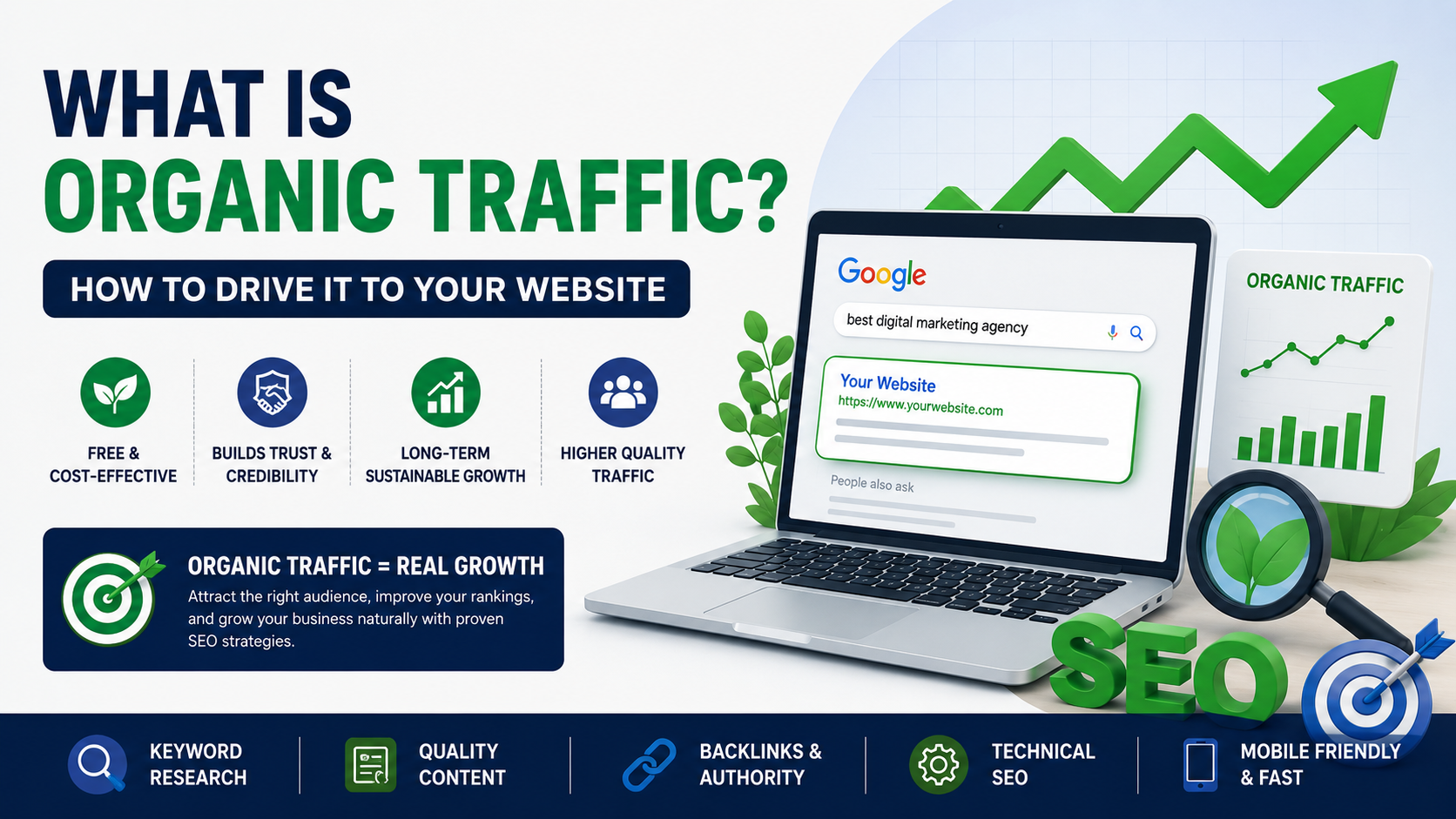
What is Organic Traffic and How to Generate It for Your Website?
As markets develop and the business world evolves, gaining greater visibility online becomes increasingly essential for attracting better leads and closing more deals via the web. In this regard, organic traffic presents perhaps the greatest opportunity. Differentiated from paid advertising, Google and other search engines direct organic visitors traffic to websites and make this traffic one of the most sustainable and cost-effective digital marketing tactics.
Whether you run a small business, an eCommerce and retail business, or a blog, having the ability to attract organic traffic to your website can foster healthy business growth.
We are going to share everything you need to know about organic traffic, including its benefits and how it can impact the overall performance of your website, followed by actionable tips to increase your organic traffic and secure long-term business success.
Understanding Organic Traffic
Organic traffic, by definition, is web visitors that arrive to your site by way of search engine results, promotional advertisement or sponsored content excluded. If a search engine user were to input a keyword and click your site in the results, it would be considered organic traffic, and the user would be considered an organic visitor.
For instance, someone who searched for:
“Best digital marketing agency,”
“How to improve SEO,” or
“Home remedies for glowing skin”
and subsequently clicked a hyperlink to your website is an organic visitor.
Organic traffic can originate from any of the following:
Google Search
Bing Search
Yahoo Search
DuckDuckGo
and any other search engine.
This is the type of traffic that all website owners are pursuing and should, because the users are actively searching for information, products, or services that you support.
Benefits of Organic Traffic
There are many long-lasting advantages that come along with driving organic traffic. Below we explain the top advantages of gaining organic traffic.
1. Economical Advertising
With organic traffic generation there is no need to pay per click. With organic traffic generation no recurring expenses related to clicks need to be spent. Organic traffic generation continues to draw traffic long after the initial investment, making the impact on expense significantly lower.
2. Improves Reputation and Confidence
There is a higher level of trust in organic results compared to driven paid clicks. Due to the appearance of paid ads, consumers feel there is less authority with listings.
3. Effects Last Awhile
When a paid advertisement is no longer funded, it is no longer visible, drawing website traffic. The opposite affects organic traffic, drawing organic traffic.
4. Quality Traffic
When traffic is being driven organically, the search intent is better, which is better for business and draws more traffic to the website.
5. Improved Organic Growth
There is better growth with organic traffic compared to paid traffic as there is loss of growth/income once the paid traffic has ended.
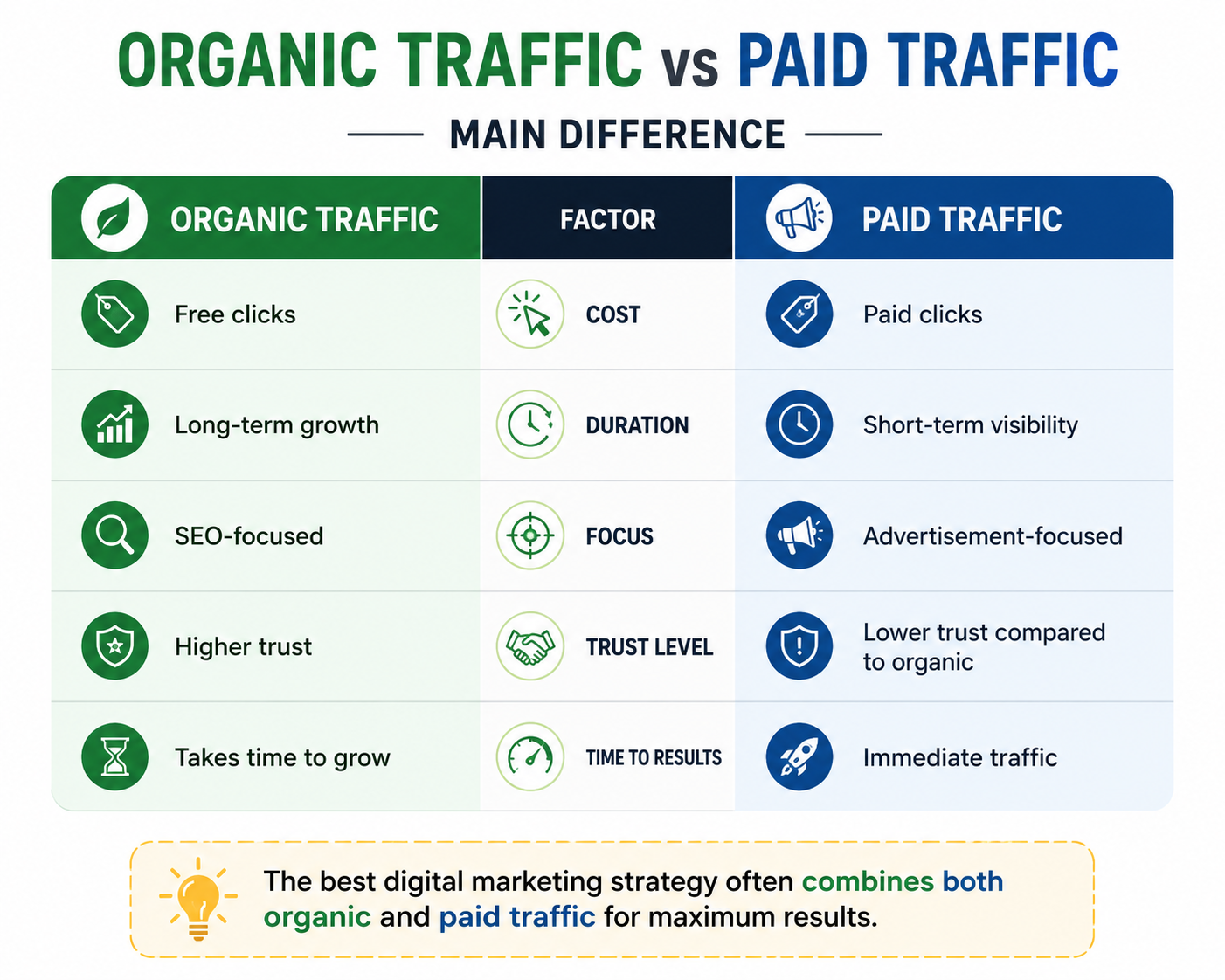
The Difference in Organic vs Paid Traffic
Paid and organic traffic are often compared with one another. Both are critical to the success of the business and no traffic generation means no business.
Organic Traffic
Traffic that originates from a search engine result without paying for ad clicks is called organic traffic.
Characteristics:
– Clicks are free
– Sustainable results
– Strategy relies on SEO
– More trustworthy
– Growth is consistent
Example:
Users organically find a blog that lines up with Google’s result for “best SEO tips“.
Paid Traffic
Paid traffic is results from advertisement clicks, and a business has to pay for each click or view.
Characteristics:
– Immediate results
– Budget for ads is required
– Results are based on a PPC strategy
– Visibility stops after advertisement ends
– Achieves objectives quickly
Example:
Google Ads appearing at the top of search results.
Organic Traffic and Website Performance
There is a measurable impact on the growth of the site and the performance of the site. Websites that do well in organic searches are likely to do well in performance.
1. Increases Authority of a Website
An incentive that search engines showcase a site that is proven to cover useful content. Traffic that is organic discounts a search engine’s relevance and quality.
This increases:
a. Domain authority
b. Search rankings
c. Visibility on brand
2. User Engagement Increased
Traffic that is organic has users that spend time on a site because the traffic is seeking content that is relevant.
A site has better engagement if:
a. Page views are greater
b. High session time
c. Bounce rate is low
3. Rates of Conversion Improve
Since the traffic that is organic is searching with intent, the users are more likely to do the following:
a. Buy products
b. Fill out forms of inquiry
c. Join a newsletter
d. Reach out to businesses
4. Growth of a Business is Supported
Traffic that is organic in high volume can produce:
a. Sales growth
b. Leads growth
c. Brand growth
d. Loyalty in a customer base
Businesses with excellent strategies in SEO typically have the upper hand in their niche.
5. Search Results Improve
When favorable interactions occur on your site, search engines view them as desirably.
Positive indicators consist of:
Excellent CTR (Click Through Rate)
Minimal bounce rate
Extended user sessions
All of these factors can improve website rankings and elevate organic visibility.
Methods to Increase Organic Traffic to Your Website
To successfully increase organic traffic to your website, you need to step up your SEO (Search Engine Optimization), consistently improve the quality of your on-site content, and improve your website. Here are several of the best techniques to help you increase the organic traffic to your site:
1. Prioritize SEO (Search Engine Optimization)
To generate organic traffic to your site, you must first prioritize SEO.
Website traffic-related key areas of focus for SEO are:
On-Page SEO
Writing optimized site page and post titles and descriptions
Natural keyword usage
Inclusion of internal links
Image SEO
Technical SEO
Site speed and optimization
Site mobile optimization
Inclusion of HTTPS
Removal of broken links
Off-Page SEO
Backlinks
Social mentions
Guest diluting
Mentions of your brand
SEO as a whole, gives a site’s content more context for search engines.
2. Produce Quality Content
Content is a huge driver of organic traffic to sites. Content should contain:
Content that is informative,
Content should also include
Proper content keyword optimization
Content should also, in its many formats include content that is User-Problem Solving
Examples of popular content include:
Text-based content like Blog posts or articles
Explanatory content like how-to guides and instructional content
Informative content like case studies
Visual content
Video content
Google prefers content that is user-friendly and informative.
3. Aim for the Right Keywords
A purposeful keyword strategy is important for increasing organic traffic.
A keyword strategy should focus on:
Keywords with lower levels of competition
Higher search intent phrases
Long-tail keywords
Examples of keyword usage include:
“best digital marketing company”
“SEO tips for beginners”
“how to improve organic traffic”
Natural keyword usage is best. Keyword stuffing is to be avoided.
4. Consider the Mobile User
Most of the time, websites are accessed using mobile smart devices.
Mobile optimization is key for
User experience
Search rankings
Website engagement
Make sure your site:
Loads fast
Uses responsive design
Uses readable fonts
Offers easy navigation
5. Improve Website Loading Speed
If your site is slow, it affects rankings and satisfaction.
To boost speed, consider:
Compressing images
Using caching
Minimizing unnecessary scripts
Choosing fast hosting
Using Internal Linking
Internal links direct users and search engines on your site.
Benefits of internal linking include:
Better page indexing
Increased page authority
Higher user engagement
Link related blog posts and service pages
7. Build High-Quality Backlinks
Quality backlinks lead to:
Domain authority
Trust
Higher rankings
To achieve backlinks, consider:
Guest blogging
PR outreach
Business directories
Creating shareable content
8. Update Old Content Regularly
Updating older blogs helps supplement rankings.
Update old blogs and refresh:
Statistics
Keywords
Images
Internal links
New information
Google likes fresh content.
How to Check Organic Traffic of a Website
To measure the success of your SEO, tracking the volume of organic traffic to your site is essential.
Tools used to check organic traffic:
1. Google Analytics
Google Analytics is free and the best tool to monitor organic traffic.
Track the following with this tool:
The visitor count and where they came from, what they do on the site and the bounce rate
Convert data
From this, search engine visitors can be identified.
2. Google Search Console
Google Search Console is very useful for SEO and providing organic traffic.
It displays:
Search impressions
Clicks
Keyword rankings
CTR performance
Indexing issues
This tool helps you get better results for an organic search.
3. SEMrush
One powerful tool SEMrush provides is:
Estimates of organic traffic
Tracking of keywords
Competitor analysis
Analysis of backlinks
SEMrush can be used for sophisticated SEO techniques.
4. Ahrefs
Ahrefs gives the ability to see:
Keywords
Website authority
Growth of website traffic
Competitor analysis
Ahrefs is used by many SEO specialists across the globe.
5. Ubersuggest
Ubersuggest is a good tool for:
Understanding keywords
Estimating traffic
SEO auditing
Content ideas
Ubersuggest uses a freemium model.
Analyzing Organic Traffic
Analyzing organic traffic provides the window into evaluating if current strategies are working, and if not, the areas to improve.
Metrics that yield good analytics:
1. Organic Sessions
This is the measure of users arriving via search without a monetary incentive.
An increase in organic sessions is a direct measure of SEO.
2. Bounce Rate
Bounce rate is a way to measure the interaction of users leaving the website.
A lower bounce rate is better:
Users are experiencing optimal interaction
Content of the website is relevant
Users are engaged with the website
3. Average Session Duration
This is the measure of the users and how long they stay on the website.
The users staying longer is often an indicator of engagement.
4. Keyword rankings
Measuring keyword rankings is a good way to measure overall SEO and track individual keywords, and also measure those keywords performing, and those that are yet to perform.
5. Conversion Rate
Any traffic meant to convert must do part of its job.
This can be tracked through:
Purchases
Lead generation
Sign ups
Contact submissions
Investing in organic traffic is more valuable than paid traffic. It reduces spending on clients, and builds visibility, authority, and trust to a lasting degree.
Businesses can achieve sustainable online growth by knowing what organic traffic is, deploying good SEO, creating high quality content, and continuously monitoring efforts to make adjustments.
All businesses, from startups to established companies, including those operating in the blogging space, will benefit from the investment of time and resources for organic traffic.
Digital marketing and website growth now and in the future will depend on the focus of organic traffic.
Stay informed, Stay ahead and Stay inspired with WebMatriks