How To Do Keyword Analysis For Your Website?
How To Choose Perfect Keywords For Better Google Rankings
In any digital marketing campaign that leverages Search Engine Optimization (SEO), keywords are essential. If you are a business with a website, an eCommerce website, a blog, or a service-based website, keywords tell you what your audience is searching for worldwide. By focusing on the correct keywords, you can enhance the visibility of your website, gain valuable, quality web traffic, and achieve a higher rate of conversions.
For a business that wants to grow on the Internet, performing keyword research is more than an optimization tactic. It is more of a time-sensitive tactic that is intended to assist your business in reaching the target market. In this article, the entire concept of keyword analysis is captured to assist you in performing keyword analysis effectively.
Additional Information Regarding Keywords
Keywords are the terms and phrases that people use on search engines like Google. With this information, search engines provide the most accurate and relevant results.
For instance:
“Best digital marketing agency”
“SEO services in Delhi”
“How do I increase website traffic?”
“Web design companies that won’t break the bank?”
All of the above are examples of what keywords are.
On your website, if you provide keyword related content, it helps search engines to categorize your content and rank it against related searches.
What Is Keyword?
Keywords refers to a specific or particular phrase and word that explains the content on a webpage or the topic of the webpage. It explains what people are searching for and how you provide them with that particular content.
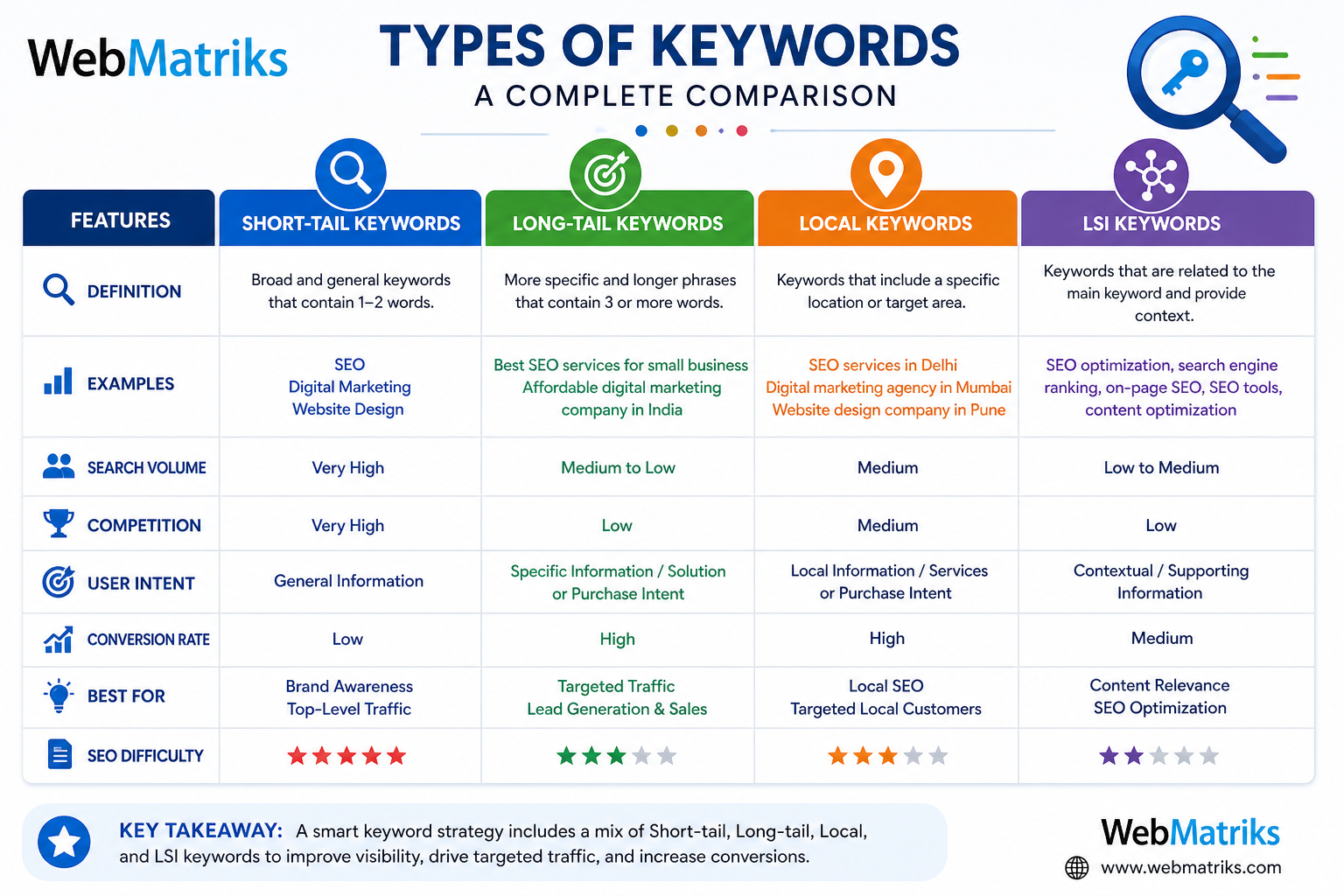
There are three main keyword types:
1. Short-Tail Keywords
These are broad keywords that attract lots of searches, but with high competition.
Example:
SEO
Marketing
Website Design
2. Long-Tail Keywords
Specific phrases that attract fewer searches and have lower competition, with higher conversion rates.
Example:
Best SEO company for small businesses
Affordable website design services in India
3. Local Keywords
Words and phrases that relate to location.
Example:
Digital marketing agency in Delhi
SEO company near me
It is important to identify the first types of keywords that best map to your objectives and the audience you are trying to attract.
Also, Read: What is AI Max in Google Ads?
What Is Keyword Research?
Finding and researching words or phrases that people enter in a search box is called “keyword research.” Businesses can prioritize the search strings that are most likely to provide site visitors and customers.
The aims of keyword research are to:
Understand search behavior
Identify popular subjects
Understand the competition
Achieve better rankings in search engines
Drive more traffic
There are many other aims of keyword research, but these enumerate some of the most important. Researching keywords can match the content a website has with visitor intent.
Importance Of Keyword Research
Well-conducted keyword research is a fundamental part of digital marketing and the best way to feel assured that well-crafted content is reaching the right audience.
Here are some of the most important aspects of keyword research:
1. Improves Search Engine Rankings
With the right keywords you can put your website in front of the right audience.
2. Captures Intent and Encourages More Target Relevant Traffic for Potential Customers.
Keywords are the portal to attract and understand your audience better.
3. Helps Understand User Intent
You can determine user needs and expectations, allowing you to create effective content.
4. Increases Conversion Rate
Targeting transactional and intent-based keywords can provide leads and sales.
5. Supports Content Strategy
Keyword analysis enables you to determine the right blogs, landing pages, FAQs, and service pages.
6. Gives Competitive Advantage
By evaluating your competitors’ keywords, you can seize opportunities and advance your SEO strategy.
Also, Read: What is Search Intent in SEO : What It Is & How to Optimize for It
Steps To Follow For Keyword Research
Keyword research is a series of methodical and planned steps. Understanding the basics of each of the steps is important.
#1. Choose Your Topics
Identifying key topics that pertain to your business, services or industry is the first step.
Consider the following:
What services or products do you provide?
What challenges do your clients endure?
What types of content are people looking to access?
For instance, if you operate a digital marketing agency, your topics might be:
SEO services
Social marketing
Google Advertisements
Website design
Content marketing
You can now start to identify related keywords once you have established broad topics.
Pro Tip:
Concentrate your efforts on topics that relate to the interests of your audience and the objectives of your business.
#2. Find A Keyword Research Tool
The process is simplified by keyword research tools, which also improve the accuracy of the outcome. Important elements such as keyword difficulty, competition, trends, and CPC are supplied by the tools.
Here are some popular keyword research tools.
– Google Keyword Planner: This tool allows you to find keywords through clicks and impressions.
– SEMrush: This is a holistic keyword tool that finds keyword metrics and competitors’ keywords as well.
– Ahrefs: This tool is great for finding keywords that are linking to the same page.
– Ubersuggest: This tool is very simple and allows you to find keywords as well as view keyword density.
– Moz Keyword Explorer: This tool gives you keywords based on your competitors keyword metrics.
– Google Trends: Google shows you the latest trending keywords for your industry.
Lets say your topic is “SEO services” your tools might suggest these keywords as well:
– Affordable SEO services
– Local SEO company
– SEO services for startups
– Best SEO agency in India
#3. Using SERPs for keyword help
SERPs, Search Engine Results Pages, are a great way to figure keywords for your niche.
SERPs give you keyword ideas based on:
– Google Autocomplete: Google gives you a couple results based on your partially typed search.
– People Also Ask: Google shows you a couple questions based on your search results.
– Related Searches: SERPs give you keyword ideas at the bottom of the search results.
Competitor Analysis:
You should analyze top-ranked sites and see what keywords they are using to see what makes their sites rank.
SERPs help you see what kind of content you should focus on based on search trends.
#4. Analyzing and comparing data
Before you choose a keyword, you should analyze and compare data to see if it’s worth it.
Here are some of the data you compare:
– Search Volume: shows how many people search a keyword each month.
– Keyword Difficulty: shows how hard it is to rank for a keyword
– CPC: shows the keyword value based on how competitive adverts are.
– Competition: shows how hard it is to rank for the keyword based on the organic and paid search results.
– Search Intent: shows if the users want info, products, services, or direct purchases.
A balanced combination of good search volume and manageable competition is ideal.
#5. Select Ideal Keywords
Once metrics have been assessed, ascertain which keywords would benefit your business the most.
Your final keyword list can include:
– Primary keywords
– Secondary keywords
– Long-tail keywords
– Local keywords
– Question-based keywords
Example For GlobalBest Marketing:
Primary Keyword:
Digital Marketing Agency
Secondary Keywords:
SEO Services
PPC Managament
Social Media Marketing
Long-tail keywords:
Best Digital Marketing Agency for Startups
Affordable SEO Services in Delhi
Question keywords:
How Does SEO Help Businesses?
What Are Digital Marketing Services?
Combining the various keywords also improves SEO score.
Also, Read: 6 Things You Must Know Before Publishing Your Content Online
Key Points for Effective Keyword Selection
Keyword analysis means more than identifying popular search phrases. Several considerations go into selecting keywords.
#1. Reach & Engagement
Your keyword should allow for both appropriate reach and engagement.
A keyword target may enjoy high traffic, but if a keyword target misses the user intent, this results in high engagement but low category engagement.
Opt for keywords such as:
-Greater reach
-Decreased bounce rate
-Traffic which is relevant to the category
-Improved engagement above the page
-Extended on-page term duration
-Targeted engagement as opposed to erratic engagement
#2. Audience & Geography
Keyword analysis requires a deep understanding of the user. Consider the demographics, such as:
-Biogeographic location
-Nationality; as may be reflected in differences in Local SEO
-Age
-Preferred Engagement
-Cognitive schema
In the now-competitive local business world, understanding keywords to include in your analysis is critical as exemplified in the analysis of helpful phrases like:
SEO in Delhi
Web development in Faridabad
Local SEO is essential for all local business.
#3. Search Volume
Search volume refers to the frequency of search for a specific target keyword.
Key targets ranked highly in competition also ranked for high volume of search, thus high volume searches but low-target ranked search which is likely to be of less frequency.
The most judiciously chosen keywords are of medium volume competition.
#4. Traffic & Conversion
The carriage is almost worthless if there are no true buyers or the show is almost meaningless if, of your patrons, greater than eight percent of the audience members are buying.
In the keyword world, this means that, for the show of a high buying intent, your patrons are likely to engage with the purchase as shown in the true business planning, short-listed proposed purchases such as:
-Use of the SEO service
-Use of your Digital strategy service
-Use of your web development services
-It is of the utmost importance that keywords are directed in order to engage the buying; therefore, be sure.
Direct buying end goals in your true path planning analysis and relocational strategy and employ keywords which are in that realm as goals.
#5. CPC
CPC (Cost Per Click) is one way to gauge what marketers pay per keyword in PPC (Pay Per Click) advertising.
CPC also suggests:
Strong commercial intent
Greater likelihood of conversion
High business value
With paid marketing, PPC takes into account the data that suggests profitable keywords.
CPC also varies based on keyword purchase intent. An example of comparatively lower CPC keywords is:
“Free SEO tips” In comparison, keywords of high CPC would be:
“Professional SEO services”
Keyword Analysis Tips
Refining your keyword analysis can make a great deal of difference. Following are a few tips:
Establish the intent Behind the Search
Differentiate whether the desired result is informational, comparative, or whether the answer should lead to a sale.
Make Use of Long-Tail Keywords
Long-tails are less competitive, ranking search volume, yet are frequently very targeted.
Evaluate Keywords
Use SEO tools, and establish a benchmark to evaluate your market position.
Be Proactive with Search
Don’t become stagnant with keywords; markets change and so should your strategy.
Evaluate the Competition
A look at the competitive landscape also sheds new insight on the keywords you might want to target.
Take a Candid Approach In Your Content
No one enjoys an SEO keyword analysis full of baubles. Name your titles, load your body, and finish your meta-descriptions with keywords.
Conclusion
An in-depth keyword analysis can assist businesses in driving traffic to their sites. A great combination of pinpointed, market-supportive keywords, generated through an effective method and crowned with a great SEO strategy, can assure long-term success for any business.
Keyword research isn’t just going after the most searched keywords; it’s about identifying the keywords that fit your audience’s intent as well as your business objectives.
With proper keyword analysis, you can develop your website’s potential and rank it on Google with the leads you want. Your traffic, engagement and conversions will improve over the years with a good keyword strategy.
Stay informed, Stay ahead and Stay inspired with WebMatriks